Posts

Second law of thermodynamics | Numerical problems and short answer questions collection | Grade 12 NEB (Physics) | Physics in Depth

Image
Second law of thermodynamics Consider a container with rigid walls partitioned into two separate walls with a valve such that a gas is put in one part and other part is created a vacuum. Now, the valve is opened and the gas eventually occupies both the parts of the container. Is the reverse possible? i.e., put the gas in both the parts of the container with the valve open. Is it possible for the gas go into one part and evacuate the other part all by itself? Ofcourse , NOT . It does not even violate the first law of thermodynamics but still the reverse process does not occur. This is explained by the another law called the second law of thermodynamics . Second law of thermodynamics can mainly be stated by following two statements: Kelvin's statement : It is impossible to get a continuous supply of work from a body by cooling it to a temperature lower than that of its surroundings. Clausius statement : It is impossible for a self acting machine unaided b...

First law of thermodynamics | Notes | Short answer questions discussion | Numerical problem solutions | Grade 12 NEB (Physics) | Physics in Depth

Image
First law of thermodynamics Thermodynamic system is any macroscopic system (i.e., the system involving extremely large number of particles ). Thermodynamic systems may be closed (exchange of energy(heat or work) between system and the surroundings but not the matter) , open (exchange of energy and matter between the system and the surroundings) and isolated (no exchange of energy and matter between the system and the surroundings). Thermodynamic parameters are measurable quantities associated with the system, such as the pressure P , the volume V and the temperature T . A thermodynamic state is the set of thermodynamic parameters that are required for the description of the system. For e.g., ( P , V , T ) is the thermodynamic state that describes the thermodynamic system having pressure P , the volume V and the temperature T . A thermodynamic system is said to be in thermodynamic equilibrium when the thermodynamic state ...

Transfer of heat / Rate of heat flow | Notes | Short answer questions and Numerical problems solutions | Grade 11 NEB (Physics) | Physics in Depth

Image
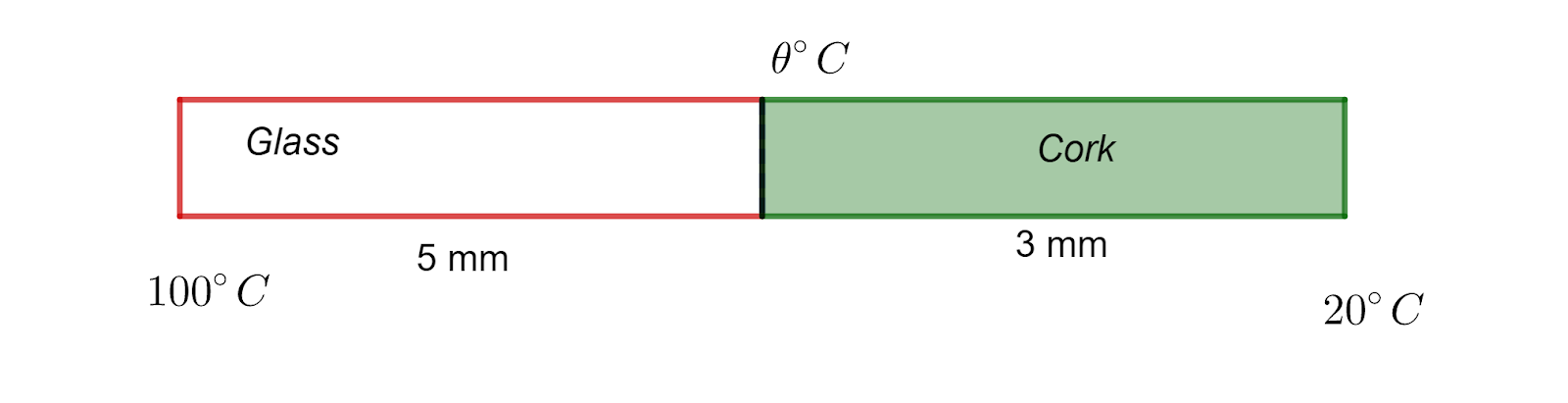
Transfer of heat Heat can be transferred from one place to another by three different methods : Conduction, Convection and Radiation. Conduction is the process in which heat is transferred through a material without the movement of material. It usually takes place in solids. Convection is the process in which heat is transferred through a substance from one point to another with the actual movement of the heated particles. It takes place in liquids and gases. Radiation is the process in which heat is transferred from one place to another directly without heating the intervening medium. Thermal conductivity is the measure of ability of a material to conduct heat. Coefficient of thermal conduction or Thermal conductivity is expressed as, \[k=\frac{Qx}{A (\theta_2-\theta_1) t}\] Here, k is the thermal conductivity, Q is the quantity of heat flowing through the material, A is the area of the material, t is the time for w...

Hygrometry | Triple point | Conceptual notes | Short answer questions and numerical problem solutions | Grade 11 NEB (Physics) | Physics in Depth

Image
Hygrometry Hygrometry is the branch of physics that deals with the amount of water vapour present in the atmosphere. When the space contains the maximum possible amount of water vapour it can hold at the given temperature, the vapour is called saturated vapour. When the space contains less than the maximum possible amount of water vapour it can hold at the given temperature, the vapour is called unsaturated vapour. The pressure exerted by a saturated vapour is called saturated vapour pressure . It is denoted by the symbol SVP. The saturation vapour pressure of a substance is constant at a given temperature. It increases when the temperature is increased. Boling : If we heat the liquid, the average kinetic energy of the entire liquid increases and at a certain stage the energy becomes sufficient to break the molecular attraction. The molecules anywhere in the liquid can form vapour bubbles. These bubbles float to the surface of the liquid and...

Ideal gas | Conceptual notes | Numerical problem solutions | Short question answer discussion | Grade 11 (Physics) | Physics in Depth

Kinetic theory of gases The kinetic theory of gases relates the macroscopic properties of gases (e.g., pressure , temperature ) to the microscopic properties of gas molecules (e.g., speed, kinetic energy ). The kinetic theory of gases attempts to develop a model of the molecular behaviour of an ideal gas. Assumptions of kinetic theory of gases : All gases are made up of molecules moving randomly in all directions. The size of a molecule is much smaller than the average separation between the molecules. The molecules exert no force on each other or on the walls of the container except during collision. All collisions between two molecules or between a molecule and a wall are perfectly elastic. Also, the time spent during a collision is negligibly small. The molecules obey Newton's laws of motion. When a gas is left for sufficient time, it comes to a steady state. Pressure exerted by the gas on the walls of...

Gases and Gas laws (Ideal gases) | Conceptual notes | Complete solutions to short questions and numerical problems | Grade 11 (Physics) | Physics in Depth

Image
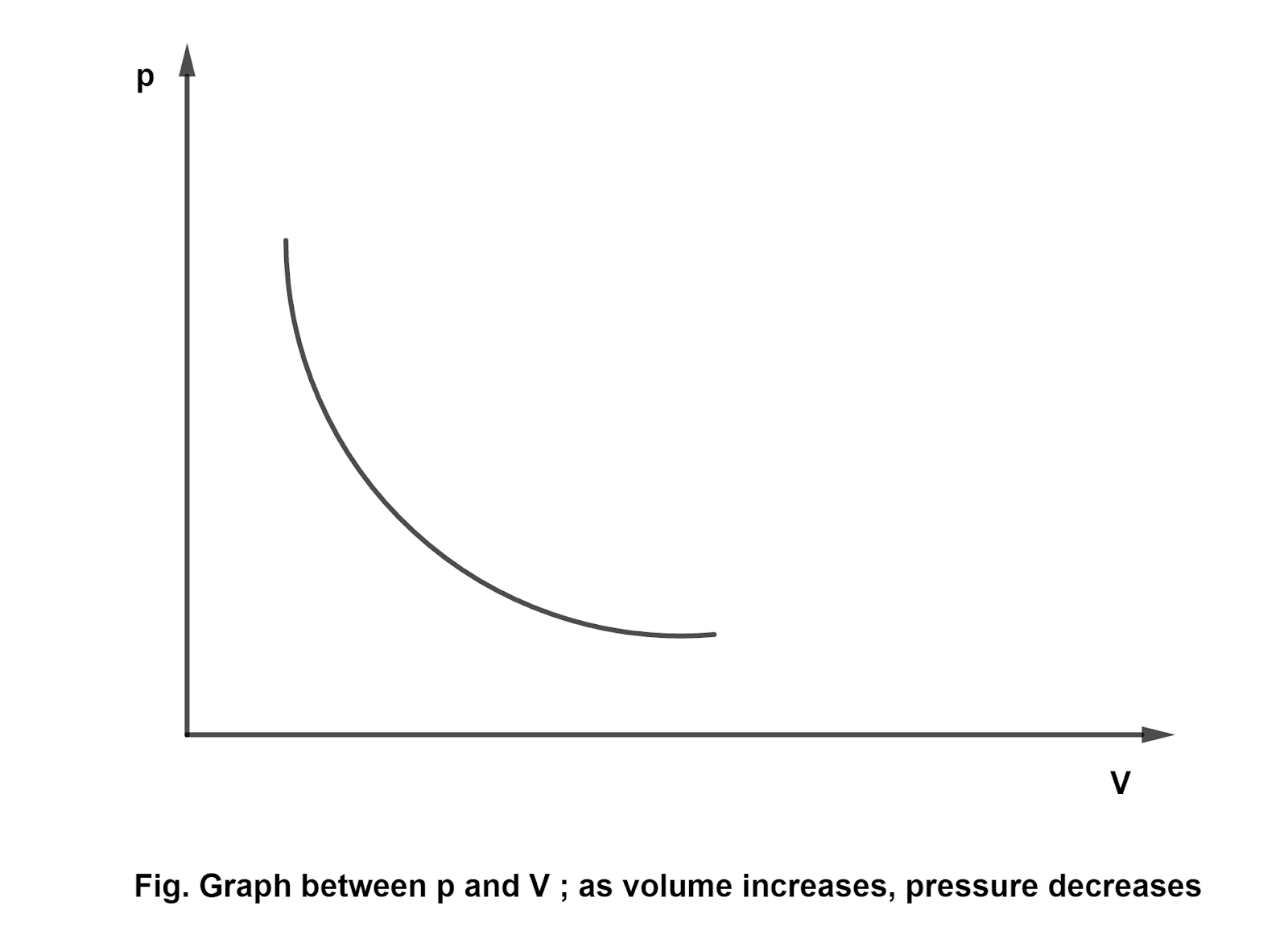
Gases and Gas Laws The thermal expansion of gas is very large compared to those of solids and liquids. To state the condition of a gas, its temperature, pressure and volume are required. The relationship between temperature, pressure and volume of a gas can be expressed in very simple laws, called the Gas laws and reduced to a simple equation called the equation of state ( PV = nRT ). Dalton's law of partial pressure : It states that total pressure exerted by a mixture of gases is equal to the sum of the partial pressure of the individual gas when there is no chemical interaction between them . If \(p_1\) and \(p_2\) are the pressure exerted by the gas '1' and gas '2' when mixed, then the total pressure of the mixture is \[p=p_1+p_2\] Boyle's law : It states that, On temperature keeping constant, the volume of the given mass of a gas is inversely proportional to the pressure . i.e., \[p \propto \frac{1}{V...